
|
|
| |
|
|
| |
Frequently
Asked Questions |
|
| |
|
|
| |
- Who can wear
contact lenses?
- I have dry eyes,
can I wear contact lenses?
- I have allergies,
can I wear contact lenses?
- My eyes are bothering
me, can I wear contact lenses?
- I have astigmatism,
can I wear contact lenses?
- I wear bifocal
glasses, what are my options in contacts?
- Can contact lenses
damage cornea?
- Are there any
risks of wearing contact lenses?
- Will I experience
discomfort or pain when using contact lenses?
- How long does
it take to adjust to wearing contacts?
- Can I wear makeup
with my contact lenses?
- Can I play sports
or work out while wearing contact lenses?
- My 10 year old
child wants to wear contacts, what should I
do?
- Can my child
wear contact lenses during sports activities?
- Can I go swimming
while wearing contact lenses?
- Can I travel
by airplane while wearing contact lenses?
- Can I wear contact
lenses if I have had refractive surgery?
- How do I know
if contacts are right for me?
- What's the difference
between daily-wear and extended-wear lenses?
- Can I sleep
in my contact lenses?
- What if I fall
asleep with my daily contact lenses in?
- How do tinted
contact lenses work?
- How do I know
which color is best for me?
- Can I share
contacts with someone else?
- Can I use my
eyeglass prescription for ordering contacts?
- Do I need to
see an eye doctor, if I want to wear contacts?
- Why do I need
a prescription, I just want lenses to change
my eye color?
- Why do I need
a recent prescription for contact lenses?
- How long is
my contact lens prescription good for?
- How do I read
my contact lens prescription?
- Do I still need
regular eye exams once I get contact lenses?
- Do I need to
keep my glasses once I get contact lenses?
- How often should
contact lenses be changed?
- How do I know
if my contact lenses need replacement?
- Can I continue
to wear my disposable contact lenses if they
are still comfortable after the recommended
wearing period?
- If I only wear
my 2-week disposable contacts part time, do
I still have to replace them every 2 weeks?
- What type of
contact lens is best if I want to wear only
once or twice a week?
- Can I continue
to wear my lens that has a very small tear at
the edge but it doesn't trouble me?
- I keep tearing
my lenses, what could be the problem?
- How can I tell
if my contact lens is inside out?
- How can I find
out if I have swapped the contact lenses in
my eyes?
- Can contact
lenses fall out of eyes?
- How do I tell
if I have lost the lens from my eye?
- Can contact
lenses slip to the back of eye or be "lost"
behind the eye?
- My contact lens
is dislodged from its position, what should
I do?
- I have always
used hard contact lenses, can I switch to soft
lenses?
- Do gas permeable
contact lenses absorb water?
- My contacts
lift up on my eye, what could be the problem?
- My contacts
feel dry all the time, what should I do?
- My contacts
hurt when I insert them, what could be the problem?
- Whenever I wear
contacts, I get a watery discharge in my eyes,
what should I do?
- Can I store
my contacts in homemade saline?
- Can I store
my contacts in tap water?
- Can I store
my contacts dry?
- How long can
I store a contact lens after it has been removed
from its package?
- How long are
my unopened contacts good for?
- What do contact
lens cleaning solutions do?
- There are so
many solutions out there, which one should I
use?
- Are contact
lenses difficult to take care of?
- I forget to
clean my contacts on a regular basis, can I
still wear contacts?
- I want to order
my contact lenses and fitting exam done, what
is the next step?
|
|
| |
|
|
| |
Q:
Who can wear contact lenses? |
|
| |
A:
Contact lenses can be worn by just about
everybody to correct just about any eye
condition. They can correct near-sightedness
and far-sightedness,
as well as astigmatism
and presbyopia.
Contact lenses can even be worn by people
who don't need vision correction, but who
simply want to change their eye color. Remember,
contact lenses may not be a good choice
for you if you have repeated eye infections,
suffer from severe allergic reactions, have
dry eyes,
or are in a dusty environment. |

 |
|
|
| |
|
|
| |
Q:
I have dry eyes, can I wear contact lenses? |
|
| |
A:
You are less likely to be comfortable
with contact lenses than someone who has normal
eye lubrication. However, you may choose to wear
your lenses only occasionally. You can increase
the comfort of your lenses by putting eye lubrication
drops.
|
|
| |
|
|
| |
Q:
I have allergies, can I wear contact lenses? |
|
| |
A:
Yes. Sometimes people experience discomfort
during the peak of their seasonal allergies.

If that happens to you, visit your eye doctor.
Your doctor may suggest that you simply
reduce your wearing time or discontinue
wearing your lenses until the allergy symptoms
have disappeared. Thoroughly and frequently
cleaning your lenses may help reduce allergy
discomfort. In addition, never use eye drops
that are not made for contact lens wearers
when you are wearing your contact lenses. |
 |
|
|
| |
|
|
| |
Q: My eyes are bothering
me, can I wear contact lenses? |
|
| |
A:
It is not advisable to wear contact lenses if
your eyes are bothering you, particularly if the
discomfort is related to contact lens wear.
|
|
| |
Top |
|
| |
Q: I have astigmatism,
can I wear contact lenses? |
|
| |
| A:
There are many kinds
of contact lenses available now which will
correct astigmatism, both in soft and gas

permeable materials. There is a special
type of soft lens called a "Toric"
lens, which is designed with different curvatures
on the front and back to compensate for
the astigmatism. They are more difficult
to fit and a lot more difficult to manufacture,
therefore tend to be more expensive than
standard soft lenses but are widely available
now, you can even get monthly disposable
toric lenses. |
|
|
|
| |
|
|
| |
Q: I wear bifocal
glasses, what are my options in contacts? |
|
| |
A:
You have three options: (1) wear bifocal contacts
in both eyes; (2) wear one contact for distance
vision, and one for near vision, this option is
called monovision; or (3) wear your distance correction
in the contacts, and wear reading glasses when
needed.
|
|
| |
|
|
| |
Q: Can contact lenses
damage cornea? |
|
| |
A:
No, if you follow all prescribed steps
for inserting, removing and caring for them. Contact
lenses are a safe and effective vision correction
device. As a contact lens wearer, you should see
your eye doctor on a regular basis to ensure good
corneal health.
|
|
| |
|
|
| |
Q: Are there any risks
of wearing contact lenses? |
|
| |
A:
Any time a foreign
object is placed in the eye; there is an
increased risk of problems. Therefore, it
is highly recommended that you follow your
eye doctor's instructions about caring and
cleaning of your contact lenses and see
your eye doctor for regular follow-up exams.
Contact your eye doctor, if you experience
any problems such as unexplained eye discomfort
or pain, redness of the eye, watering eyes,
or decrease in vision. |

 |
|
|
| |
|
|
| |
Q: Will I experience
discomfort or pain when using contact lenses? |
|
| |
A:
Most first time wearers are delighted with the
level of comfort that contact lenses provide.
Initial contact lens fittings by an eye doctor
can minimize any irritation associated with new
lenses. After a brief adjustment period, most
people report they can no longer feel contact
lenses on their eyes.
|
|
| |
Top |
|
| |
Q: How long does it
take to adjust to wearing contacts? |
|
| |
A:
It depends upon you and the type of lens.
People with dry

eyes may have greater difficulty
adjusting to and wearing contact lenses.
Soft contact lenses usually take only several
days to a week. On the other hand, hard
contact lenses may take several weeks to
two months before they can be worn comfortably.
At first, contact lens wearers may experience
some scratchiness, redness, tearing, sensitivity
to light and occasional blurred vision.
|
|
|
|
| |
|
|
| |
Q: Can I wear makeup
with my contact lenses? |
|
| |
A:
Yes. Try to avoid getting makeup on your
lenses. Always insert your lenses before applying
eye shadow, eyeliner, and mascara.
|
|
| |
|
|
| |
Q: Can I play sports
or work out while wearing contact lenses? |
|
| |
|
A:
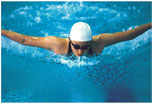
Yes, contact lenses are an excellent
option for sports and work out enthusiasts.
They may also improve your peripheral vision,
depth perception, hand / eye or foot / eye
co-ordination, and increase your overall
performance. Unlike glasses, contact lenses
are more stable and flexible. They don't
steam up from perspiration, don't smudge
and don't fog up if you go from cold to
warm temperatures. Contacts don’t
slide down, or fall off even during vigorous
movements. Contact lenses also make it easier
for you to wear protective safety goggles. |
|
|
|
| |
|
|
| |
Q: My 10 year old
child wants to wear contacts, what should I do? |
|
| |
A:
It should be discussed between the doctor
and the parent as to whether the prescription
indicates contacts and whether the child is mature
enough to follow instructions properly.
|
|
| |
|
|
| |
Q: Can my child wear
contact lenses during sports activities? |
|
| |
A:
Yes, contact lenses provide
excellent vision for most sports. However, they
should also use polycarbonate sports safety goggles
or glasses when participating in sports.
|
|
| |
Top |
|
| |
Q: Can I go swimming
while wearing contact lenses? |
|
| |
| A:
Generally speaking,
you should not swim in your contact lenses.
This is for two main reasons. Firstly, it
is very easy for the lenses to be washed
out of the eye by a small wave or if you
place your head under the water. Secondly,
the lenses, especially the soft ones, will
absorb chlorine or microorganisms from the
water. They will then stay in or on the
lens for several hours, irritating the eyes
and possibly causing infection.
Exposure to pool water may also cause contact
lenses to adhere quite firmly to you eyes.
If this occurs, leave the lenses in the
eyes until the natural tears replace the
pool water. |
|
| You
can get readymade watertight prescription
swimming goggles that are safe for swimming.
For those involved in active water sports
should seriously consider LASIK surgery
for vision correction. |
|
|
| |
|
|
| |
Q: Can I travel by
airplane while wearing contact lenses? |
|
| |
A:
The low humidity in airplane cabins causes dry
eyes and contact lens discomfort.
It may help to put lubrication drops in your eyes
before you enter the aircraft or during the flight.
If discomfort continues, it is probably easiest
to wear eyeglasses when flying.
|
|
| |
|
|
| |
Q: Can I wear contact
lenses if I have had refractive surgery? |
|
| |
A:
Yes, but the refractive surgery will have change
the curvature of your cornea, requiring a more
specialized lens than normal. It is best to consult
your eye doctor.
|
|
| |
|
|
| |
Q: How do I know if
contacts are right for me? |
|
| |
A:
It depends on your prescription,
your eye health, visual need, and your lifestyle.
Only a comprehensive contact lens examination
can determine if your sight can be adequately
corrected with contact lenses. If you work in
a dusty environment or exposed to bright, windy
conditions much of the time, eyeglasses may be
safer and more comfortable to wear.
|
|
| |
|
|
| |
Q: What's the difference
between daily-wear and extended-wear lenses? |
|
| |
A:
Daily-wear contact lenses are designed
to be removed each day for cleaning, and should
be taken out before you sleep or nap. Extended-wear
lenses can be worn continuously for up to seven
days before they are removed for cleaning.
|
|
| |
Top |
|
| |
Q: Can I sleep in
my contact lenses? |
|
| |
A:
Yes, but remember that only extended wear
lenses are designed for this purpose.
|
|
| |
|
|
| |
Q: What if I fall
asleep with my daily contact lenses in? |
|
| |
| A:
If you are wearing daily contact
lenses, you should always take them out before
you go to sleep. If, however, you do fall
asleep with them on your eyes, remove your
lenses as soon as you get up, and follow the
recommended lens cleaning and disinfecting

instructions. It may be helpful to put drops
in your eyes before removing your lenses to
moisturize them. |
 |
|
|
| |
|
|
| |
Q: How do tinted contact
lenses work? |
|
| |
|
A: Your iris is colored, but
does not affect the color of things you
see. Enhancer tints highlight a wearers
existing eye color and come in a variety
of colors including aqua, blue, green, brown,
amber and violet. Opaque tints cover the
natural color of the iris, making the eye
appear a completely different color (such
as blue over a brown iris). The wearer sees
through a clear area in the center of the
lens while showing the world a different
eye color. |

 |
|
|
| |
|
|
| |
Q: How do I know which
color is best for me? |
|
| |
A:
The color choice is up to you. In general,
choose colors that complement your hair and skin
tones. You can choose one color or several colors
to be worn all day, everyday or simply for special
occasions. |
|
| |
|
|
| |
Q: Can I share contacts
with someone else? |
|
| |
A:
No! Never
try to wear contact lenses that were not
prescribed to you directly. Even if the
lenses are cosmetic or colored lens with
no power (plano) you should not share lenses
with anyone else. Also, sharing contact
lenses can promote the spread of eye disease.
Never allow anyone else to wear your lenses. |

|
|
|
| |
Top |
|
| |
Q: Can I use my eyeglass
prescription for ordering contacts? |
|
| |
|
A:
No, you cannot use your eyeglass
prescription to order your contact lenses.
Contact lens prescription and eyeglass prescription
are different. It should be noted that the
power of a contact lens would not necessarily
be the same as that of a spectacle prescription
due to the optics of a lens being closer
to the eye. A contact lens prescription
differs from a spectacle prescription primarily
by the addition of lens parameters such
as diameter of the lenses, the base curve,
the type of material of the contact lens,
and the design or manufacturer’s name.
If these measurements are not taken by an
experienced eye care professional, your
contacts may not feel comfortable. Thus,
before you can order contacts, you must
first undergo a contact lens fitting exam.
Doctors charge an additional fee for this

fitting exam. |
 |
|
|
| |
|
|
| |
Q: Do I need to see
an eye doctor, if I want to wear contacts? |
|
| |
A:
Yes, an eye exam is needed to determine
the right contact lens fit for you. Because contact
lenses are medical devices, they need to be properly
fitted by an eye doctor. |
|
| |
|
|
| |
Q: Why do I need a
prescription, I just want lenses to change my eye
color? |
|
| |
A:
Even lenses without correction are
medical devices that can cause problems to your
eyes. If you have never worn contact lenses, you
need to be fitted by an eye doctor and taught
how to insert, remove, and disinfect them. If
you already wear clear lenses that are available
in a tint then you may substitute with a tint
without a problem. |
|
| |
|
|
| |
Q: Why do I need a
recent prescription for contact lenses? |
|
| |
A:
Your doctor has a right and a responsibility
to put an expiration date on your contact lens
prescription, to ensure that you receive regular
check-ups to rule out the possibility of long
term complications of contact lens wear that you
may be unaware of. |
|
| |
|
|
| |
Q: How long is my
contact lens prescription good for? |
|
| |
A:
Although it may vary from State to State,
normal regulations maintain that you should see
your eye care practitioner every year to update
your prescription and maintain good eye health. |
|
| |
Top |
|
| |
Q: How do I read my
contact lens prescription? |
|
| |
A:
Depending upon your visual needs,
you may or may not have all of the following items
on your prescription:
- OD (Oculus
Dextrus) is right eye
- OS (Oculus Sinister) is left
eye
- Sphere power is the actual
power of the contact lens
- Cylinder (if any) is the
power of the astigmatism correction
- Axis (if any) is the alignment
of the contact lens in the eye
- Base curve is the shape of
the contact lens
- Diameter is the distance
from edge to edge (in mm) of the lens
In most cases, the most important parts of the prescription
are the Base Curve, Diameter and Sphere power. |
|
| |
|
|
| |
Q: Do I still need
regular eye exams once I get contact lenses? |
|
| |
A:
Yes. The single best way to protect your
vision is through regular professional eye examinations.

Eye care professionals do more than provide eye
exams, they care for the overall health of your
eyes. This is especially important for contact
lens wearers because the contacts could be causing
damage to your eyes without necessarily causing
any obvious symptoms. You should see your eye
care professional regularly.
|
|
| |
|
|
| |
Q: Do I need to keep
my glasses once I get contact lenses? |
|
| |
A:
Yes. Though contact lenses provide
benefits, you should still keep your glasses’
prescription current. There may be days that you
don’t want to wear your lenses, or when
your glasses are better suited for the situation. |
|
| |
|
|
| |
Q: How often should
contact lenses be changed? |
|
| |
A:
The recommended life of contact lenses
varies depending on the type of lenses, from 1-day,
1-week, 2-weeks, 1-month, and longer. With any
contact lens, you should follow the prescribed
wear and care instructions that include guidelines
for replacement. |
|
| |
Top |
|
| |
Q: How do I know if
my contact lenses need replacement? |
|
| |
A:
Typical signs that a lens is approaching
the end of its life are hazy vision, discomfort,
and lens discoloration and deposits. These can
lead to allergies
and other complications. |
|
| |
|
|
| |
Q: Can I continue
to wear my disposable contact lenses if they are
still comfortable after the recommended wearing
period? |
|
| |
A:
No, lenses should not be worn for longer
than the recommended wearing period to stop discomfort,
dryness, blurred vision and allergic reactions
that can result from a build-up of protein and
lipid deposits on the lenses.

|
|
| |
|
|
| |
Q: If I only wear
my 2-week disposable contacts part time, do I still
have to replace them every 2 weeks? |
|
| |
A:
No, the 2 weeks refers to the actual
time of wearing, so they can last longer than
2 weeks if you are not wearing them full time. |
|
| |
|
|
| |
Q: What type of contact
lens is best if I want to wear only once or twice
a week? |
|
| |
A:
Soft contact lenses, especially dailies,
are most appropriate for occasional wear. |
|
| |
|
|
| |
Q: Can I continue
to wear my lens that has a very small tear at the
edge but it doesn't trouble me? |
|
| |
A:
Absolutely not. Never wear a lens that
is obviously damaged, even if it feels all right.
It could be causing damage to your eyes that might
not be immediately apparent. In addition, never
wear a lens, which is uncomfortable, causing pain
or leaves your vision hazy or distorted.
|
|
| |
|
|
| |
Q: I keep tearing
my lenses, what could be the problem? |
|
| |
A:
It could be your long fingernails
or you are closing the case on the contacts. Use
a thicker lens. |
|
| |
Top |
|
|
Q: How can I tell
if my contact lens is inside out? |
|
| |
A:
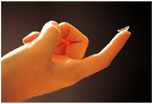
Soft lenses will appear as a smooth dish
shape when placed on the end of a finger and when
the lens is the right way inside. Another test
is to add saline, drop by drop to fill the bowl.
If the edges begin to curl inwards, it's the correct
way.
|
|
| |
|
|
| |
Q: How can I find
out if I have swapped the contact lenses in my eyes? |
|
| |
A:
Check the vision of each eye by covering
alternate eyes with your hand. If the vision is
unclear then try swapping the lenses and then
recheck the vision. |
|
| |
|
|
| |
Q: Can contact lenses
fall out of eyes? |
|
| |
A:
Generally not. With normal use, contact
lenses will stay firmly in position. However,
they can come out under certain conditions. High
winds can cause the eyes to water and pull the
eyelid tight against the eye, increasing the chance
of lens loss. A sharp blow to the head may dislodge
rigid gas permeable lenses. And rubbing your eye
carelessly may result in a lost lens.
|
|
| |
|
|
| |
Q: How do I tell if
I have lost the lens from my eye? |
|
| |
A:
Cover the other eye to determine if vision
is still clear from the eye where you suspect
that you have lost the lens. If vision is blurred
then more than likely the lens is either dislodged
from the cornea or has fallen out of the eye.
|
|
| |
|
|
| |
Q: Can contact lenses
slip to the back of eye or be "lost" behind
the eye? |
|
| |
A:
No. There is no place for it to go. There
is a thin, transparent membrane, called conjunctiva
that covers the sclera (white part) and inside
of your eyelids is well attached to the sidewalls
of the eye socket. This forms a seal which prevents
contact lenses (as well as dust and other ‘foreign’
material) passing to the back of the eye. |
|
| |
Top |
|
| |
Q: My contact lens
is dislodged from its position, what should I do? |
|
| |
A:
Sometimes contact lenses ‘hide’
beneath eyelids. If you wear soft contact lenses,
they will tend to center automatically on the
cornea. If you wear rigid gas permeable (RGP)
lenses, you may need to manipulate a displaced
lens through the eyelid. In rare instances, a
RGP lens may adhere by suction to the conjunctiva.
First, apply wetting solution to the lens and
wait about a minute. Then try to move the lens
while gently pressing on one edge. If that doesn't
work, you can try to very gently lift up under
one edge to break the seal. Or go see your eye
doctor. If a contact lens adheres repeatedly,
it is not fitted correctly and should be replaced. |
|
| |
|
|
| |
Q: I have always used
hard contact lenses, can I switch to soft lenses? |
|
| |
A:
Possibly yes. Now, there are many new
types of soft contact lenses available. Many eye
conditions, which were previously corrected only
by hard contact lenses, may now be corrected with
soft contact lenses. Make an appointment with
your eye doctor and get trial samples of soft
contact lenses. |
|
| |
|
|
| |
Q: Do gas permeable
contact lenses absorb water? |
|
| |
A:
No. They do not need to because the material
itself allows oxygen to diffuse through it making
water irrelevant. |
|
| |
|
|
| |
Q: My contacts lift
up on my eye, what could be the problem? |
|
| |
A:
It indicates increased deposits on the contacts
and / or possible allergic response of upper lids
to dirty contacts. Discard the old lenses and
use fresh ones. |
|
| |
|
|
| |
Q:
My contacts feel dry all the time, what should I
do? |
|
| |
A:
Use re-wetting drops. |
|
| |
|
|
| |
Q:
My contacts hurt when I insert them, what could
be the problem? |
|
| |
A:
There are three possibilities (1) tear
in contact; (2) increased deposits, or (3) contact
is inside out. |
|
| |
|
|
| |
Q:
Whenever I wear contacts,
I get a watery discharge in my eyes, what should
I do? |
|
| |
A:
This may be an allergic
reaction to deposits on contacts
or possibly an eye infection.
Set up an appointment with your eye doctor. |
|
| |
Top |
|
| |
Q:
Can I store my contacts in homemade saline? |
|
| |
A:
No. Home-made saline is not sterile and there
is the risk of bacterial or parasitic contamination.
Although extremely rare, the resulting infection
can be so damaging that it simply is not worth
the risk. |
|
| |
|
|
| |
Q:
Can I store my contacts in tap water? |
|
| |
A:
Absolutely not. This can result in infection.
Temporary storage in saline is OK, but the lenses
will need to be cleaned and conditioned by soaking
in an appropriate disinfecting solution prior
to use. |
|
| |
|
|
| |
Q:
Can I store my contacts dry? |
|
| |
A:
Absolutely not. Soft lenses will turn into "corn-flakes"
and pop when you touch them. Hard lenses should
also be stored in a soaking disinfecting solution
to reduce lens contamination. |
|
| |
|
|
| |
Q:
How long can I store a contact lens after it has
been removed from its package? |
|
| |
A:
This varies according to the cleaning and
disinfection routine that you use before storing
the lens. For specific details, consult the package
insert of your lens care system. |
|
| |
|
|
| |
Q:
How long are my unopened contacts good for? |
|
| |
A:
Soft lenses are good until expiration date
written on the box. Rigid Gas Permeable (RGP)
lenses are good for 2-3 years. |
|
| |
|
|
| |
Q:
What do contact lens cleaning solutions do? |
|
| |
A:
Contact lens solutions do three things: (1) clean
the lenses to remove over 90% of the germs that
can grow on them; (2) disinfect to kill any germs
on the lens to prevent eye infections;
and (3) buffer and wet the lenses to make them
more comfortable to wear. Almost all contact lenses
need to be kept wet to prevent them from changing
shape. |
|
| |
|
|
| |
Q:
There are so many solutions out there, which one
should I use? |
|
| |
A:
Do not "mix and match" contact lens
cleaning solutions. The chemicals used in one
cleaning solution could react with the chemicals
in another cleaning solution, which could damage
or discolor the lenses, irritate your eyes. Keep
your lens care products clean. Do not touch the
tip of the bottles to any surface. If you do so,
quickly discard the next few drops. Always close
the container with the original top immediately
after use. |
|
| |
Top |
|
| |
Q:
Are contact lenses difficult to take care of? |
|
| |
A:
It varies from lens to lens. The slick surface
of RGP’s resists deposit buildup, therefore
they need only daily cleaning and disinfecting
and no enzyme treatment. Daily disposable lenses
are worn only once and then discarded. Weekly
soft disposables are cleaned at the end of the
day; then soaked in disinfecting solution until
they're worn again. Since they're discarded before
deposit buildups occur, they don't need to be
cleaned in an enzyme solution either. Other soft
lenses however, usually require daily cleaning
/ disinfection and weekly enzyme treatment. |
|
| |
|
|
| |
Q:
I forget to clean my contacts on a regular basis,
can I still wear contacts? |
|
| |
A:
Yes, you can. Wear disposable contacts that have
a minimal requirement for cleaning. One of the
benefits of disposable contact lenses is that
protein cleaners are not necessary because the
lenses are disposed of before there is a large
build up of proteins. |
|
| |
|
|
| |
Q:
I want to order my contact lenses and fitting exam
done, what is the next step? |
|
| |
A:
Schedule an appointment at NeoVision Eye Center
by calling toll free at: 1-877-NEOVISION
(1-877-636-8474)
|
|
| |
|
|
| |
|
|
| <<
Back to Services |
|